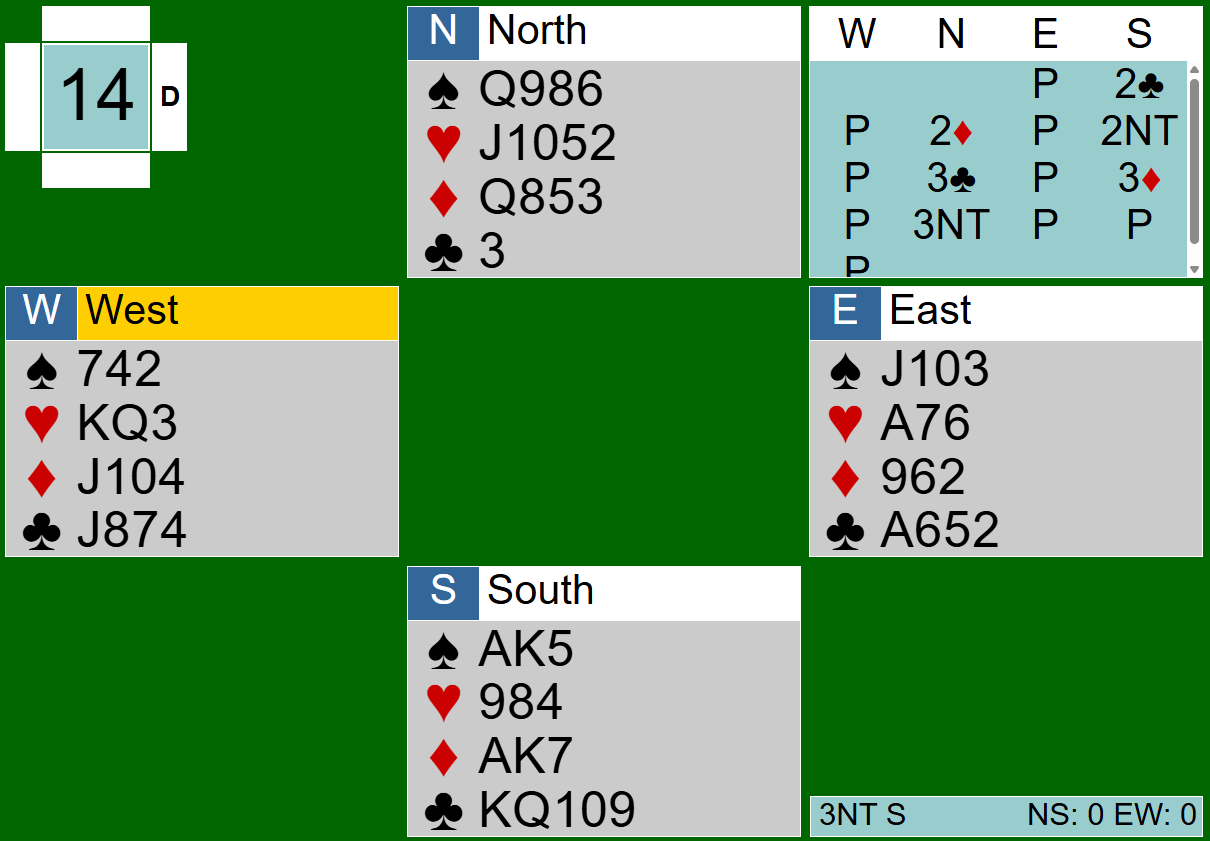
A very good player went wrong on this hand and I found it was an instructive situation. Sitting East, you have these cards:
♠️ J103 ♥️ A76 ♦️ 962 ♣️ A652
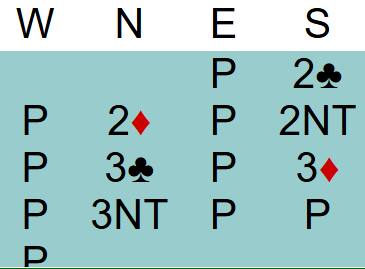
South gets the ball rolling with an alerted 2♣️. Your partner asks them about it and the bid is explained as showing either a traditional two club opening i.e. a game force, or a balanced 19-20. Partner passes and North bids 2♦️, explained as 5+. South bids 2NT, confirming the weaker variant. The auction then continues with a Stayman inquiry, upon which South denies any four card major. As expected, 3NT ends the auction.
Partner leads the ♠️7 and a weak dummy is put on the table:
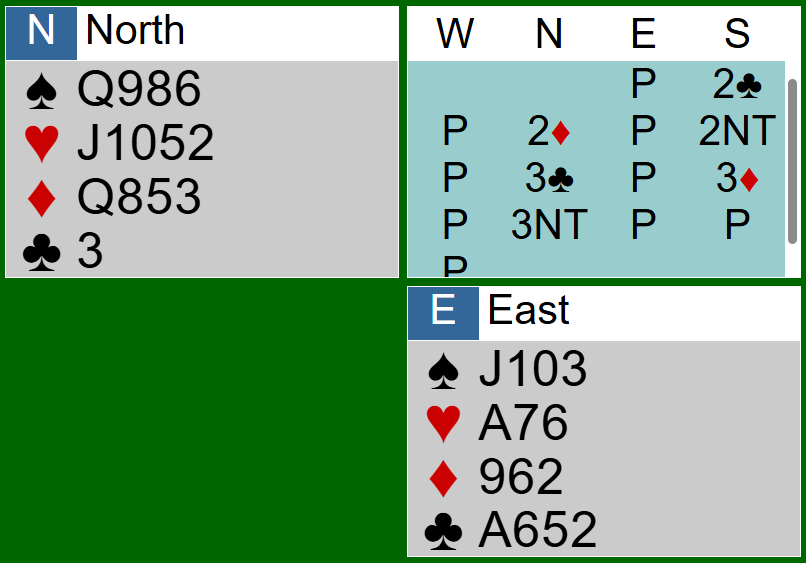
The lead is covered by the ♠️8, our ♠️10 and declarer’s King. The ♥️9 starts the next trick. Our partner wins it with the Queen, and tries another spade which goes to the 6, our Jack, and declarer's Ace. South insists on hearts, and partner wins that trick with the King. As if to demonstrate that the defense can also be insistent, partner plays the third Spade to dummy.
Declarer plays the third heart to your Ace and you have the lead in this situation:
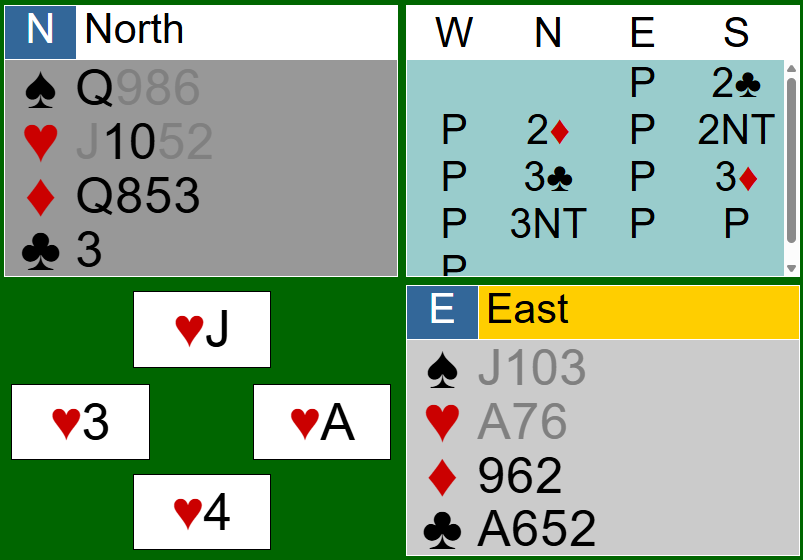
I have presented the play as it happened but we know by now that a good defender will be analyzing the hands and assembling all clues as those tricks were being played. In other words, you should not do the analytical work only after you win a trick.
Dummy had five high card points, and you had nine. That leaves 26 high card points to be divided between South and West, and you know South has 19-20. Partner has produced five of those points in hearts. That leaves a maximum of two for him.
The conclusion is that partner has at most the club Queen or Jack.
Another way to reach this conclusion would be to follow what I call the psychological viewpoint. This is often an effective shortcut. Declarer was aware that the defense could take out his entry to the last heart by persisting with spades. Her play makes little sense if she does not have another entry to dummy. Put another way, declarer’s line of play is a strong indication of her having the Ace and King of diamonds, and if you remember that she has the Ace and King of spades as well, you will see that she needs five more points to get to 19. Her hand is one of those:
♠️ AKx ♥️ xxx ♦️ AKx ♣️ KQxx
♠️ AKx ♥️ xxx ♦️ AKJ ♣️ KJxx
The correct defense at IMPs is very clear. Your only hope is to force a guess in clubs by playing a low club now. If declarer has hand (b) and tries the Jack, she goes down. And if declarer gets it right (or has hand (a)), you lost only one IMP. Solid return on your investment (losing one IMP 75% of the time to gain 10 IMPs 25% of the time).
In matchpoints, of course, the math is very different. Assuming neutral numbers (50% chance for each of the two cases, 50% chance of a misguess by declarer), you will end with 5 tricks in 25% of the cases, and 3 tricks in 75% of them. The conservative/coward play of cashing the ♣️A and running home ends with 4 tricks for the defense 100% of the time. Cashing out is the right play.
Unless you are ‘swinging for tops’, which is a situation that arises now and then, depending on how your game is going. But if you want to maximize your matchpoints in the long run, you should cash that ♣️A.
The full hand: